Teaching Your Dog to Stay
A pre-cursor to any dog training is the Reward Marker. Read the blog post here!
In this post, we’ll get into the details of how to teach your dog “stay”. Be prepared that there are three phases to train in, and you’ll also want to introduce a “release” cute to let your dog know they can break their stay. Many folks use “all done” or “break” – but you can use whatever cue works best for you, as long as you are consistent with it.
Things Your Dog Should Already Know
Before beginning to teach “stay”, your dog should already know “sit” or “down” reliably. You’ll also need to have introduced a release cue to let them know they can stop what you’ve asked them to do. Many folks use “all done” or “break” for this, but you can use whatever cue works best for you as long as you are consistent.
The Three Stages of “Stay”
There are three stages to teaching “stay”, and to start, you’ll want to train each stage individually.
- Duration (how long your dog holds the “stay”)
- Distance (how far away you are from your dog while she is in the “stay”)
- Distraction (what else is going on in the environment at the time)
Stage One: Duration
Have your dog on a flat collar and leash and work in a low-distraction environment, such as a quiet room in your home.
- Stand directly in front of your dog and stand on the leash. Ask your dog for a “sit” or a “down” position – whichever you feel will be easiest for your dog to hold for a period of time.
- Give your dog a hand signal, such as holding your hand with your palm towards them, and give the verbal cue “stay”.
- Begin to reward your dog with small treats for a few seconds while they are in the previously-cued position.
- Give your release cue (“all done”, “break”, etc) to end the stay. At this point, stop giving treats.
The idea is that treats only come while your dog is in the “stay”. Over time, slowly increase the amount of time between treats and the amount of time you are asking your dog to “stay”.
Stage Two: Distance
Once your dog is starting to build up the duration that they can stay, it’s time to start adding some distance! As with stage one, have your dog on a flat collar and leash and work in a low-distraction environment, such as a quiet room in your home. Begin as you would with duration, having your dog “sit” or “down”.
- Give your hand signal and verbal cue for “stay”.
- Take a step back while rewarding your dog with small treats.
- Give your release cue to end the Stay, at which point the treats stop.
- Slowly increase the amount of time between treats, your distance from the dog and the amount of time you are asking for the “stay”.
Once that your dog is getting the hang of “stay” with both Duration and Distance, you can up the ante and incorporate some distractions to the mix!
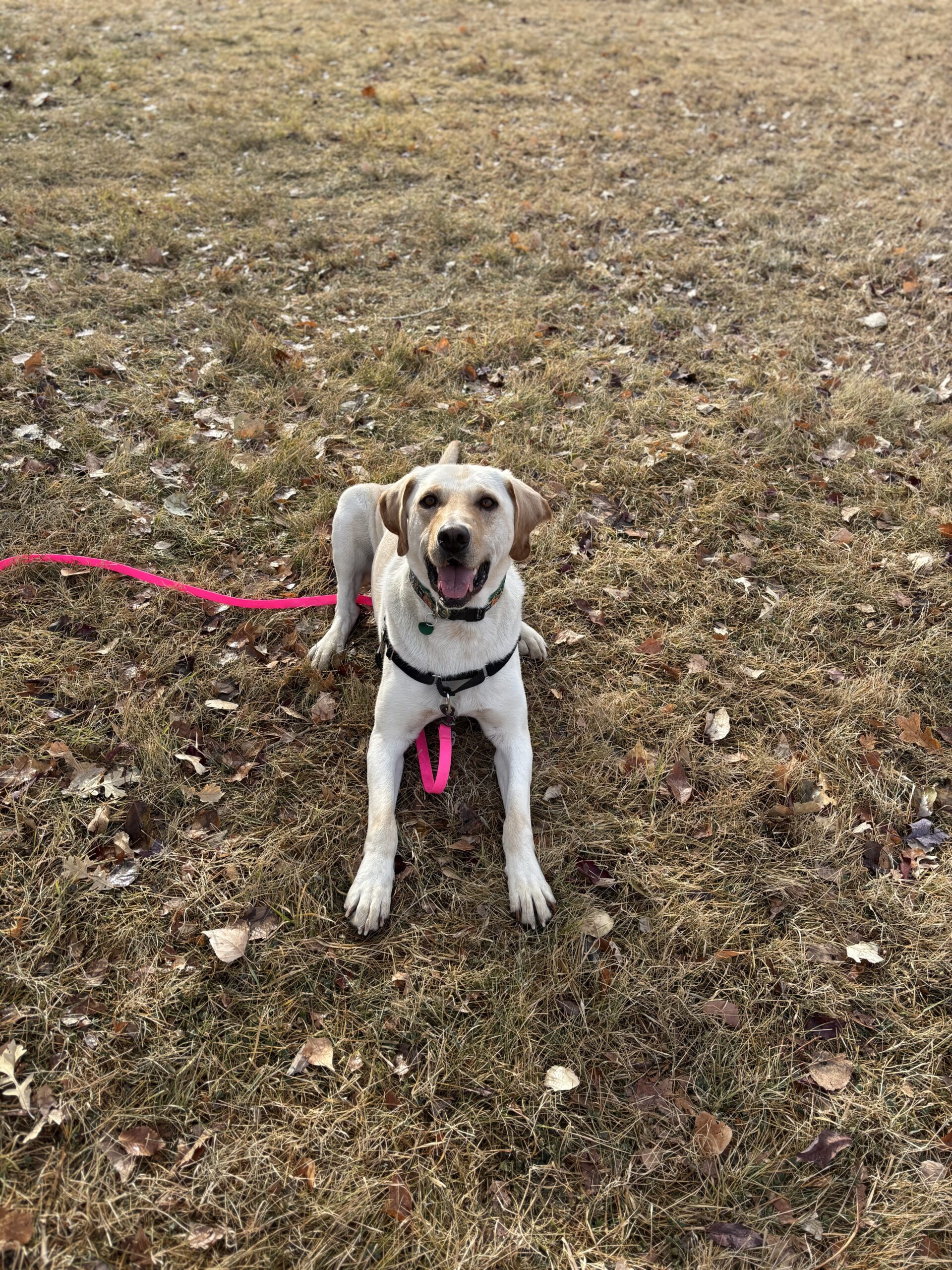
Stage Three: Distractions
Think of Distractions as anything that takes your dog’s attention away from you. This might be other people or dogs, weather, novel objects, vehicles, smells, etc.
When first teaching your dog a new cue, you’ll want to start in an area of very low distraction, such as a quiet room in your house. Once your dog is performing the cue fairly consistently, you can repeat stages 1 and 2 with gradually higher distractions.
Low Distraction Level:
- At home with no one around.
- In the backyard at a quiet time (no one in sight, no dogs barking, no squirrels, etc.)
- In a quiet room (ie a training classroom) with no other dogs.
Moderate Distraction Level:
-
In the house with other family members around.
-
In the front yard with people walking by.
-
On the sidewalk while walking towards a dog that is a fair distance away. Could also be out on a walk with a familiar dog in view.
Difficult Distraction Level:
-
In the backyard with a squirrel in view.
-
In the front yard with people your dog loves walking by.
-
In the house with family members trying to distract your dog with food.
-
Decreasing the distance out on a walk with another dog in view.
-
In a busy parking lot.
-
In the classroom with other dogs.
Intense Distraction Level:
-
At a park with lots of people around.
-
At the vet clinic.
-
In the house with family members playing with your dog’s favourite toy.
-
Further decreasing the distance on a walk with another dog in view.
-
During play with a dog.
Tips to Set Your Dog Up for Success
- When you change locations, decrease the Distance & Duration of the “stay” until your dog gets used to the new area. For example, if you’ve just started practicing in the yard, stand close to your dog, don’t ask them to hold the “stay” for long, and increase the rate of the rewards.
- Go at your dog’s pace! If you try the “stay” and your dog can’t hold the cue three times in a row, you’ve gone too fast. Go back to the last step where your dog was successful and only increase the difficulty in small increments.
- Always get your release cue in! If it looks like your dog is going to break the “stay”, say your release cue before that happens.
Patrick Chu, CPDT-KA
Behaviour Coordinator
Got ideas for our next blog? Email us at [email protected]!